
Rank videos by spike, not views
On October 7 we nearly scheduled a batch of smart-glasses videos with five hashtags picked because each matched a word in our script. Then came a plain question: which tags did the winning smart-glasses videos actually share? We pulled 49 videos that had clearly beaten their creators' usual numbers and counted. Two of our five tags appeared on none of them.
That is the quiet danger of research. It can hand back exactly what you already believed. The fix, here and in four other traps, is to stop trusting the easiest number and ask what it is compared to.
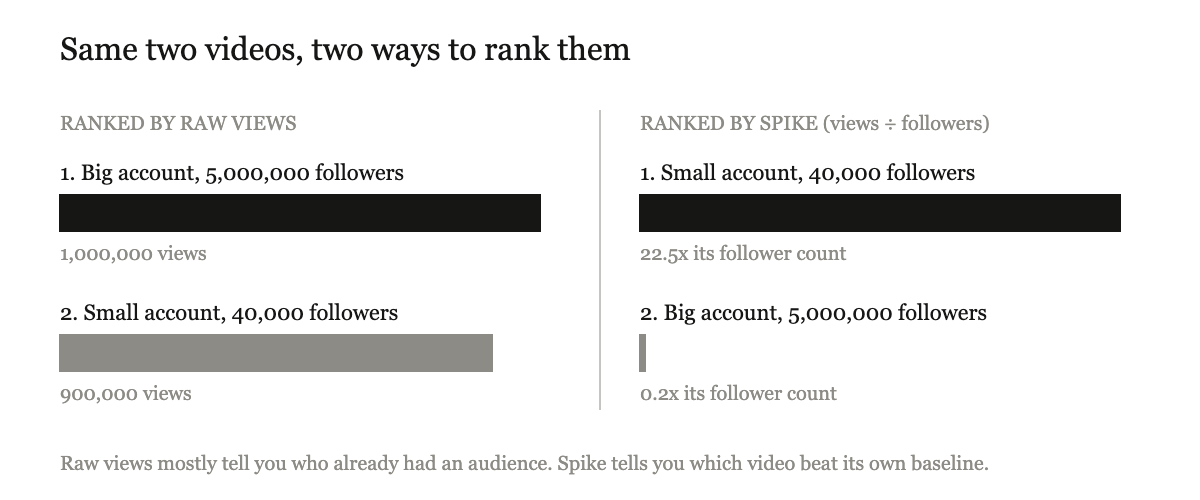
Same two videos, opposite order. Views reward the big audience. Spike rewards the video.
Why are raw views a bad way to find what's working?
Raw views mostly tell you how many people already follow a creator. A huge account gets a floor of views on nearly anything, so its average post looks like a hit. Spike, views divided by followers, takes that floor away. A 40,000 follower account with 900,000 views sits at 22.5x. A 5 million follower account with 1 million views sits at 0.2x. The first traveled far past its own crowd. The second was an ordinary day.
TikTok said something close to this in 2020. A video may get more views from a bigger account, but "neither follower count nor whether the account has had previous high-performing videos are direct factors in the recommendation system."
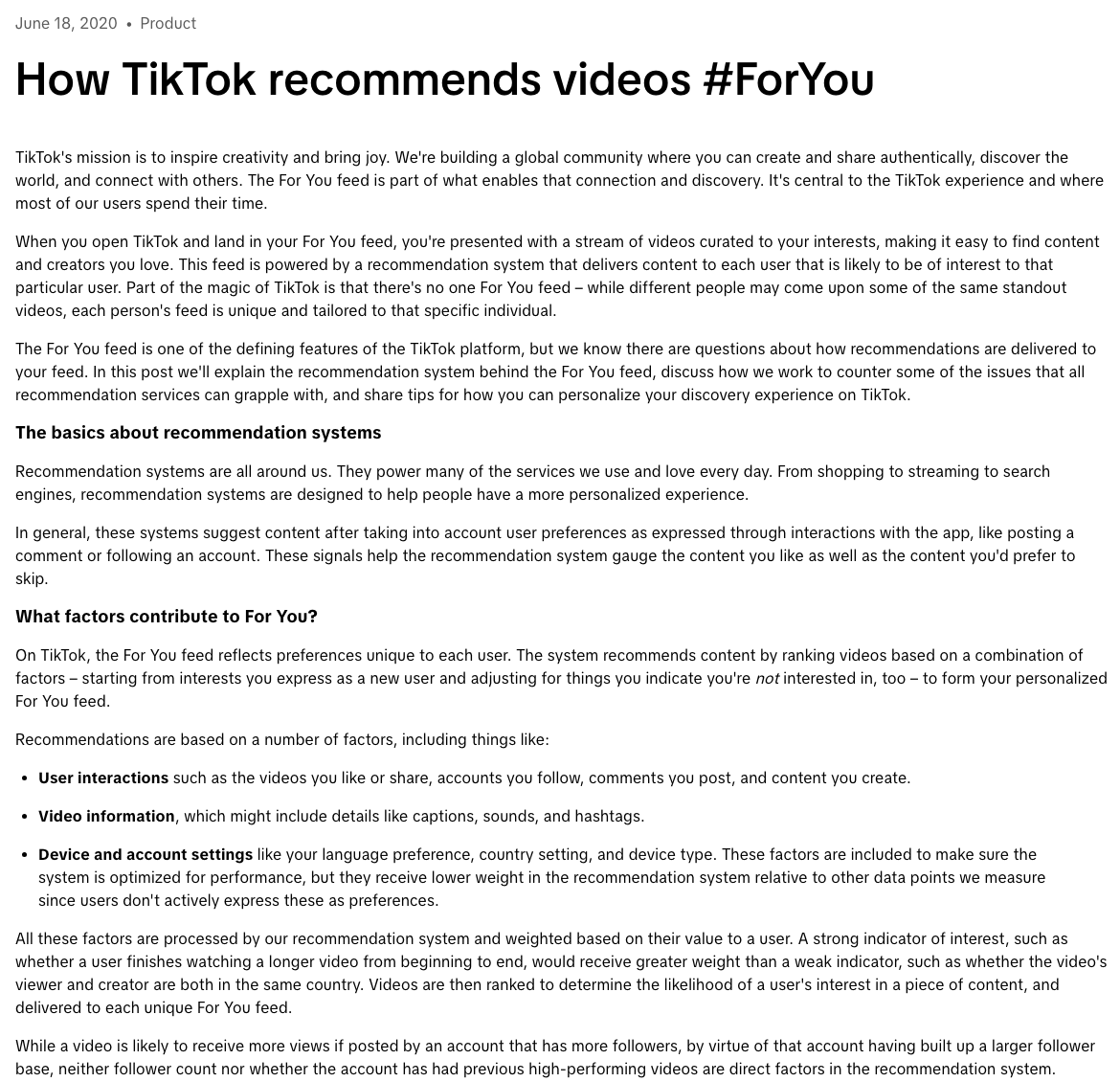
TikTok's 2020 explainer. Its last paragraph is why spike works.
Aha: followers are a head start, not a verdict. Divide by followers and you remove the starting line and keep the race. A list sorted by spike shows which videos strangers kept watching, and that is the part a newer creator can copy.
The platforms walked this road first. YouTube added watch time to its recommendations in 2012, and Cristos Goodrow, a VP of Engineering there, later wrote that the change cut views by about 20%. YouTube picked a smaller number that meant more. Tools like vidIQ now score a video against the average of other videos on the same channel. Spike is the rough short-form cousin, built from the one number every scraper gives you free: followers.
One honest catch. A 500 follower account can hit 100x by luck, so keep a follower floor by default and lower it on purpose to look for small-account explosions. And be plain about limits: no scraper shows real watch time or click-through rate. Spike is the best public clue that hidden watch signals were good, not a copy of them.
How many comments do you need to read before you claim buying intent?
Hundreds, not twenty. Buyers show up in comments as "where do I get this?" or "how much?" But page one holds about 20 comments, and a video that spiked often has 600 or more.
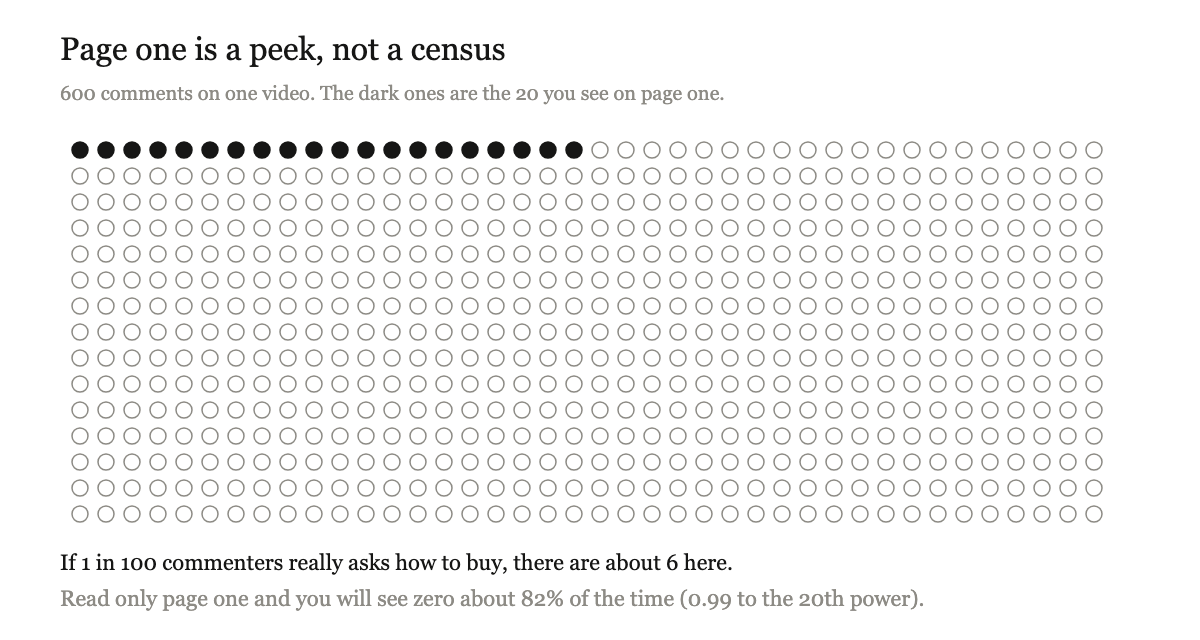
Twenty out of six hundred. Most days page one hides every buyer.
If 1 in 100 comments is a buy question, all 20 on page one miss about 82% of the time. You write "0.00% intent," and across a dozen niches every niche looks dead. Doctors solved this in 1983. Hanley and Lippman-Hand's rule of three says that zero events in N tries puts the true rate somewhere below 3 divided by N.
Aha: zero out of twenty is not zero. By that rule, zero in 20 allows a rate up to 15%. That is not a dead niche. It is no answer at all. To say a niche sits under 1%, you need about 300 comments with no buyers.
Then read the quoted questions yourself. In travel and relocation niches, "how much?" often means rent, which is not product intent. A word filter counts it anyway.
How do you run a spike research pass?
A short version of the routine we run before anything gets scheduled:
- Search the words real videos rank for, like "how to stop saying um," not a category name.
- Cut by date and topic. One run this month went from 58 queries and 6,744 results to 2,520 recent posts and 1,536 on topic.
- Compute spike for every row and roll up by creator. Two or more hits from one person suggests a format, not luck.
- Read the shortlist in full and page the comments. That run picked 87 videos and read 81 transcripts end to end.
- Count hashtags across the spike-ranked winners, then judge frames, not covers. Covers are one picture the creator chose, and their links often expire within hours.
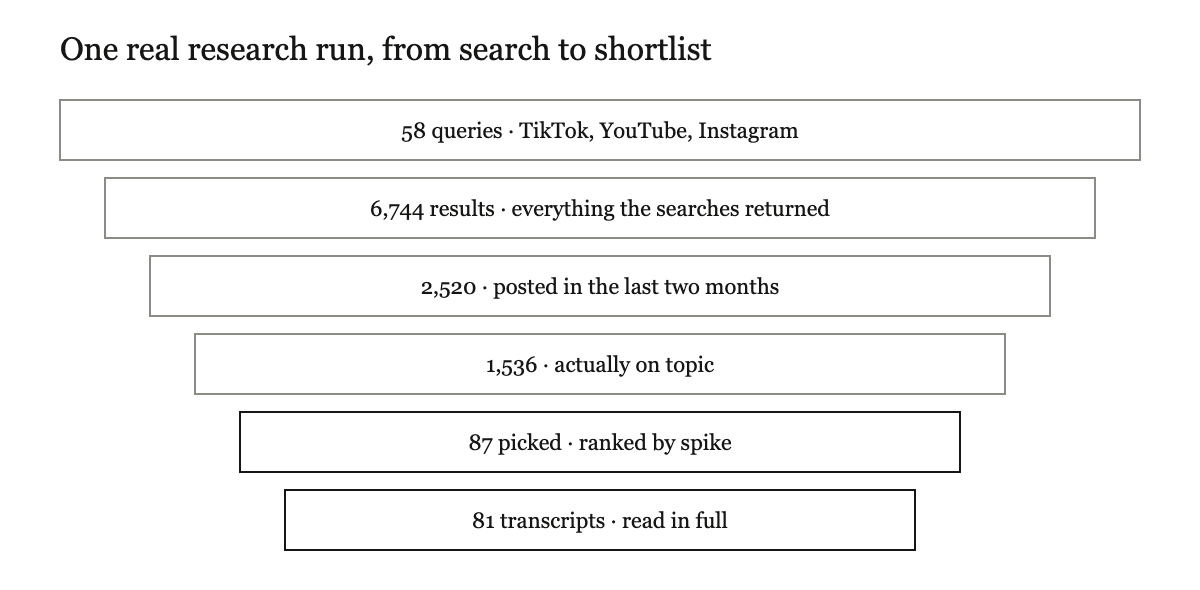
One real run. Most of the work is throwing rows away for good reasons.
To try steps 3 and 4, paste one video per line as name, views, followers in the first box, then enter your comment counts in the second.
Two people this fits. A skincare founder with budget for one account compares "barrier repair" with "acne scar journey." Views favor scar journeys, but spike favors barrier repair, and its comments ask which product it is while the scar comments mostly say "this is me." She picks barrier repair. A small agency counts tags across 50 spike-ranked winners and finds four of a client's ten never show up once, so they swap them.
I build Earshot, which turns spiking hooks in a brand's niche into videos from realistic AI creators, so I need spike to be true. Every rule above came from a number I believed that turned out hollow. Our five hashtags felt like research and were really a mirror. Next time a number makes you feel sure, divide it by something first.
Read the full article on Medium
Sources
- How TikTok recommends videos #ForYou (TikTok Newsroom, June 18, 2020)
- On YouTube's recommendation system, Cristos Goodrow (YouTube Official Blog, September 15, 2021)
- Outliers: Uncover Top Performers (vidIQ Help Center)
- Hanley JA, Lippman-Hand A. If nothing goes wrong, is everything all right? Interpreting zero numerators. JAMA 1983 (PubMed)