
A paywall up front got us 12x more trials and 1 sale
We put a paywall inside onboarding and got twelve times more free trials. Two weeks later we had one sale, and that buyer switched off renewal about an hour after paying.
The app is Earshot Teleprompter. You write a script, read it on your iPhone while looking at the lens, and an AI edit turns the take into a finished video. In October 2026 we tested where the paywall should sit. I build the product, so weigh my view with that in mind.
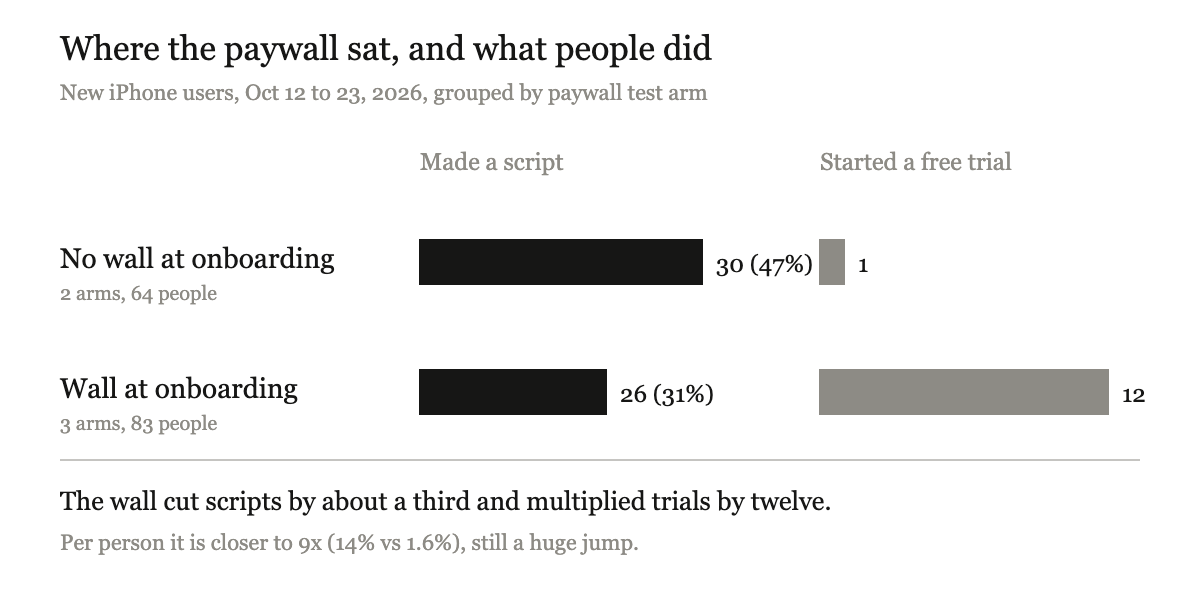
The early wall traded makers for trials.
What happened when the paywall moved into onboarding?
From October 12 to October 23 we split new iPhone users into five arms. Two arms saw no wall during onboarding. Three arms saw one inside onboarding. Nothing else changed.
The no-wall arms had 64 people. 30 of them got a script ready (47%), and together they started 1 trial. The wall arms had 83 people. 26 got a script ready (31%), and they started 12 trials. So the early wall cut script making by about a third and sent trials way up.
On a dashboard, that is an easy winner. Then the trials began to end.
Why did more trials not bring more buyers?
Most of those trials were not buying decisions. They were people unlocking the app for free and cancelling at once so they could never be charged. Since October 12 we had 16 real trials on annual plans ($59.99 for creators, $79.99 for business, with 7 free days first). 11 were cancelled, 7 of them within 10 minutes. 4 were still running. 1 was charged $79.99 and turned off renewal about an hour later.
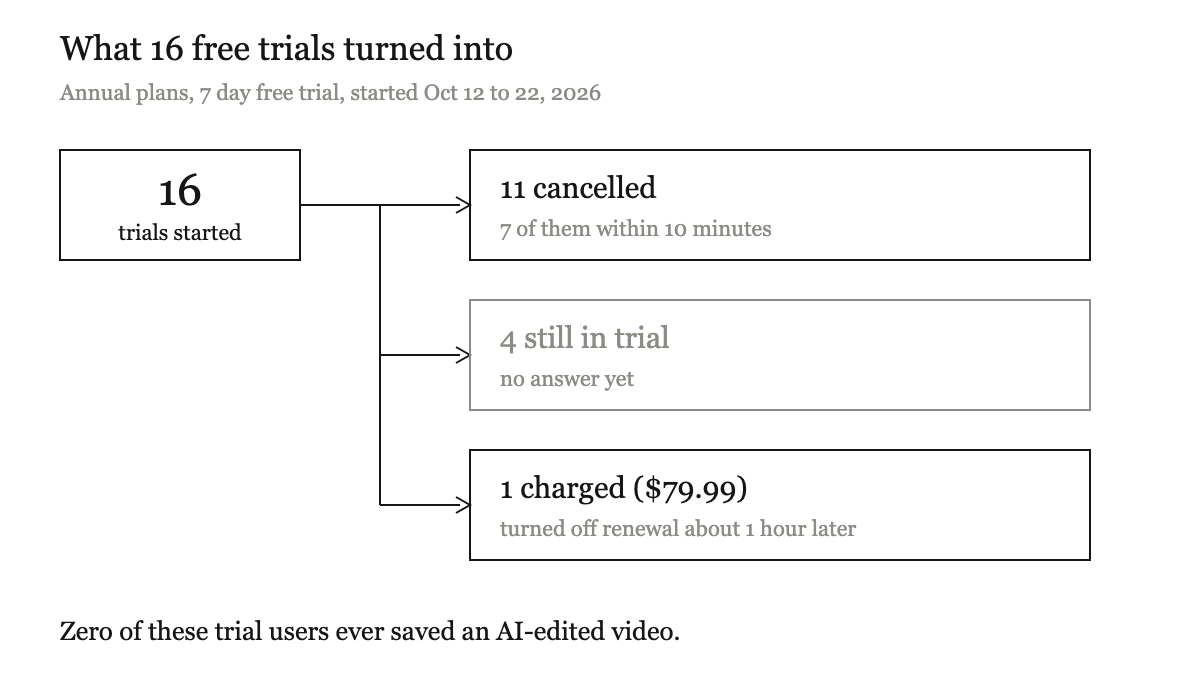
One charge out of sixteen, and it already had renewal off.
Not one trial user saved an AI-edited video, the very thing we sell. The money did not work either. One annual sale nets about $51 to $68 after Apple's cut, and ads cost us about $17 to $35 per trial. That needs 1 in 2 to 1 in 4 trials to pay. Among trials that had ended, 1 in 7 paid.
Why do people cancel a free trial right away?
Because on the App Store, cancelling early is free insurance. For most apps, a trial keeps running after you turn off renewal. Apple's subscription page says: "Their subscription begins immediately, but they won't be billed until the offer duration ends." So a careful person cancels at once and keeps the full trial.
This is common, not just our bad luck. In a May 2026 RevenueCat post, Daphne Tideman wrote: "A staggering 55.4% of 3-day trials are cancelled on Day 0."
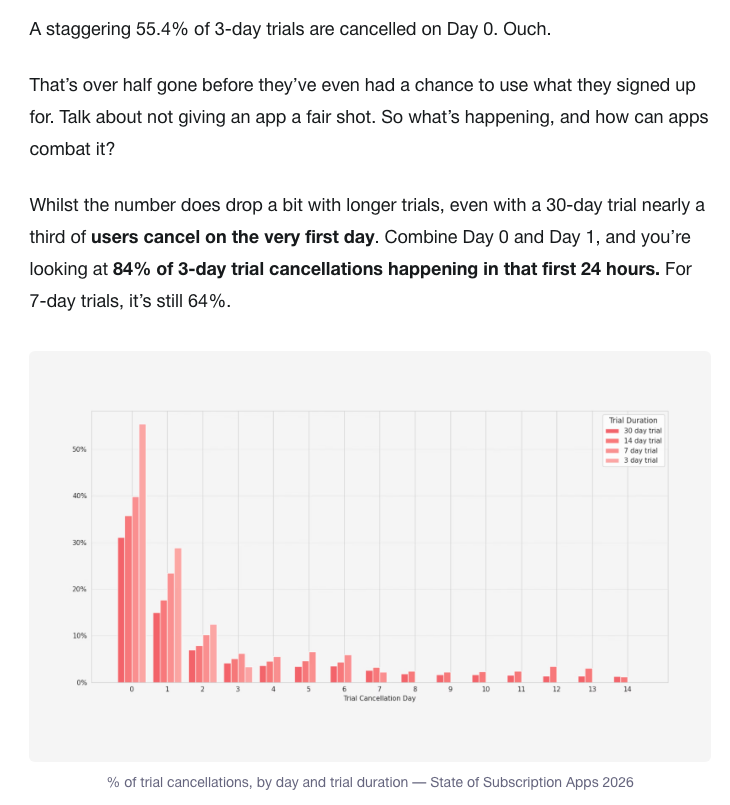
Every trial length spikes on the first day. Ours ran for seven.
The connection: a trial count measures a free click, not a buying decision.
Seen that way, the early wall did not make twelve times more people want to pay. It gave twelve times more people a free button that costs nothing to press or undo. Back in 2006, Fred Wilson warned: "Asking for a credit card even though you won't charge anything to it is not a good idea."
Is a hard paywall better than freemium?
Often, yes, if you count money. In an April 2026 RevenueCat post, David Barnard reported that "hard paywalls convert downloads to paid at a median of 10.7%," against 2.1% for freemium. That is downloads to paid, not trial starts. Compare that with Superwall's May 2026 study of more than 40 million onboarding paywall opens, which counts a trial start or a purchase as a conversion. A scorecard like that rewards anything that makes the free button easier to tap.
The connection: the common paywall scorecard rewards the exact number that lied to us.
How do you measure free trials honestly?
Here is the method in five steps.
- Pick your value event. Name the one action that proves someone got what they came for. Ours is saving a finished AI-edited video.
- Tag the instant cancels. For each trial, take the start time and the time renewal was turned off. Mark anything switched off within 60 minutes.
- Judge only trials that have ended. A trial still running has not voted yet. Ours: 1 charge from 7 ended trials.
- Count four things side by side. Free yes, reached the value event, paid, and still renewing after paying.
- Score each arm by revenue per 1,000 visitors. This catches the arm that wins on trials and loses on dollars.
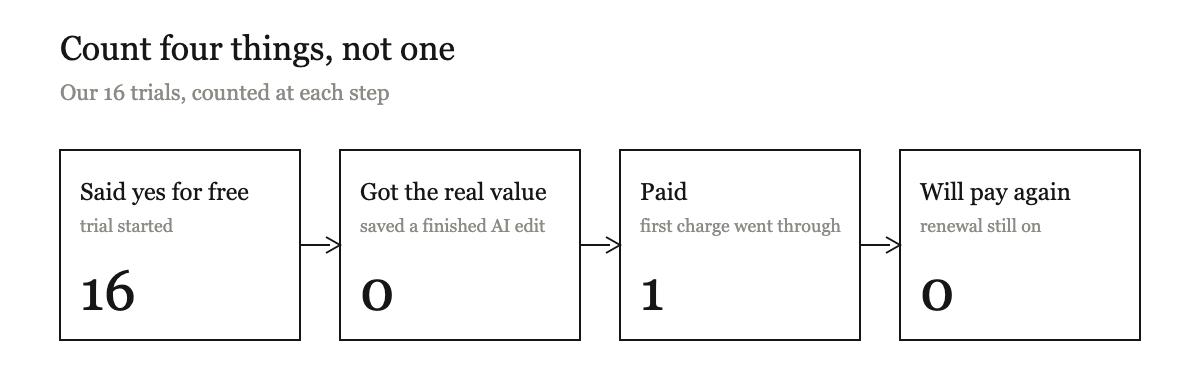
The real gap is box two: nobody reached the value.
To check your own test, type your visitors, trials started, trials cancelled in the first hour, paid conversions and price into the tool below, with an A and B column for two paywall placements.
One use case: a growth marketer buying install ads with a "start trial" goal. Cost per trial looks fine. Once he strips out instant cancels and works out cost per paying customer, the cheapest ad sets turn out to bring the most unlock and cancel trials.
What we are changing
The paywall moves off onboarding and goes after the first finished video, where it asks a harder question: was that worth paying for? We are dropping forced sign-in before purchase, since 3 of 10 people who tapped "Start trial" quit at that screen and Apple's ID is enough to buy.
Our sample is small, 147 people across five arms, so read it as a story, not a benchmark. Still, the lesson holds. What matters is not how many people take something free. It is how many pay once they have seen what you made.
Read the full article on Medium
Sources
- The post-purchase screen: how to stop Day 0 cancellations (RevenueCat, Daphne Tideman, May 2026)
- How a switch from hard paywall to freemium led to a 75% LTV lift and a 50% conversion drop (RevenueCat, David Barnard, April 2026)
- Multi-page onboarding paywalls convert 37% better than single-page (Superwall, Michal Parizek, May 2026)
- Auto-renewable subscriptions (Apple Developer)
- My Favorite Business Model (Fred Wilson, AVC, March 23, 2006)