
Love the problem, not the swords
I can make up product ideas all day. That is a trap.
On September 29, 2026, I wrote myself a note, and one line stuck: "I need to love the problem and think about truly defeating him, not coming up with swords and falling in love with the swords." Swords are solutions. The enemy is the problem.
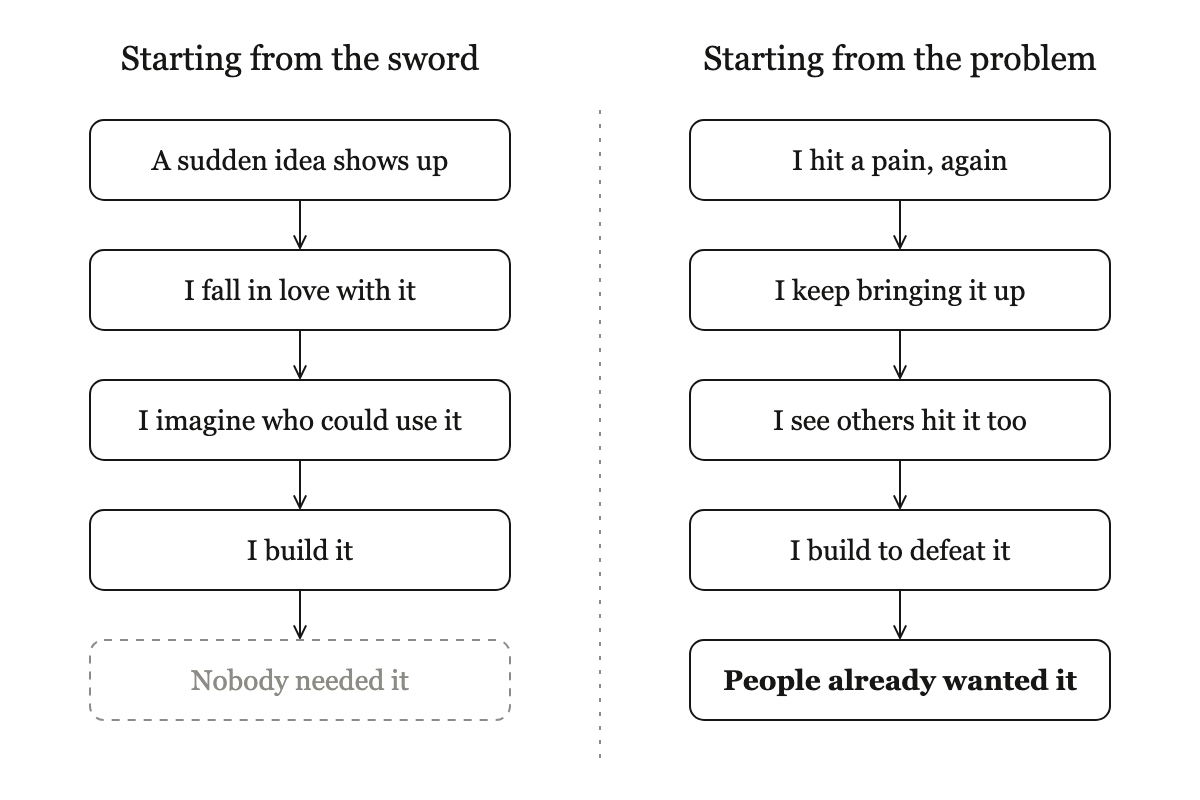
Start from the sword and you go hunting for users. Start from the problem and they are already waiting.
Why are sudden startup ideas a red flag?
A sudden idea comes from your head, not your life. If you cannot point to a problem you hit many times, and talked about before the idea showed up, you are holding a sword with no enemy.
My note admits it: "Random ideas and imaginable possibilities are easy for me to generate." With AI tools, a "what if" becomes a demo in a weekend, so I can fall for a dozen swords a month. Now a sudden idea is guilty until proven innocent.
In November 2012, Paul Graham opened "How to Get Startup Ideas" with: "The way to get startup ideas is not to try to think of startup ideas. It's to look for problems, preferably problems you have yourself." In 1995 he spent 6 months putting art galleries online before noticing galleries did not want to be online. He called the bad kind "made-up" or "sitcom" ideas: friends could maybe see using one, and "Sum that reaction across the entire population, and you have zero users."
Clayton Christensen's milkshake story, written up by Harvard Business School Working Knowledge in February 2011, shows the same thing. A chain asked "milkshake drinkers" for a better shake and sold no more. A researcher who just watched for a day saw that 40 percent of shakes were bought early in the morning by commuters with a long drive. The job caused the purchase, not the profile.
Rob Fitzpatrick's The Mom Test (2013) adds three rules: "Talk about their life instead of your idea," "Ask about specifics in the past instead of generics or opinions about the future," and "Talk less and listen more."
Aha: The Mom Test works on you too. The best liar I know is me with a new sword. "I could totally see people using this" is the future-tense fluff the book says to throw away. So I ask myself: when did this really happen to me, and what did I do?
How often do startups fail from building the wrong thing?
In March 2026, CB Insights looked at 431 venture backed companies shut down since 2023. "Ran out of capital" led the list at 70 percent, but they call that "almost always the final cause of death, not the root problem." Of the 385 with known reasons, 43 percent cited poor product market fit. Skipping the problem check just moves the waste to the end, where it costs the most.
I have done it myself. I pictured a small legal consultant using my tool, and I know none. Pitching an idea to friends felt like proof. It was not, so I wrote: "Repeatedly discussing the same solution does not clear the flag."
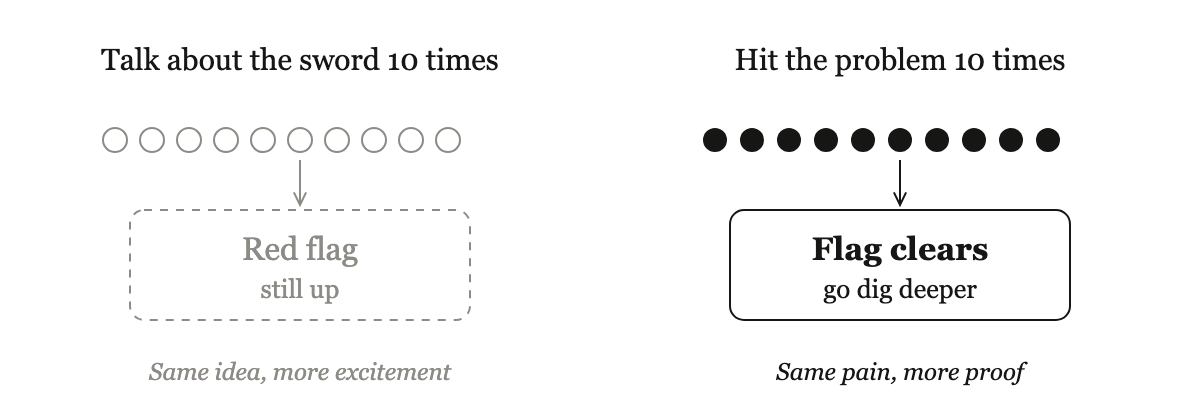
Ten pitches leave the flag up. Ten run-ins with the pain clear it.
The sentence I aim for now: "Even for me, knowing the tools and how to combine them, this is still a real pain to do and keep working." If it hurts someone who can write the glue code, it is worse for everyone else.
Aha: being good at building makes this check more important, not less. Cheap swords mean more swords. When AI writes an app in an afternoon, picking the enemy is the hard part. My notes say it in three words: "Direction before speed."
How do I check an idea before building it?
Use a plain note, with no AI open.
- Write the problem before the idea. Fill in "When I ___, I have to ___, and it costs me ___." If only the solution comes out, stop.
- Count real times, in the past. Check your notes and messages from the last 3 months. Count each time the problem hit you, and each time you raised it before the idea.
- Name real people. List people you have seen hit it and could message today. Empty means sitcom land.
- Write what they do now and where it breaks. Note where it fails and what that costs.
- Ask if you are in the group. If you are only visiting, go watch them first.
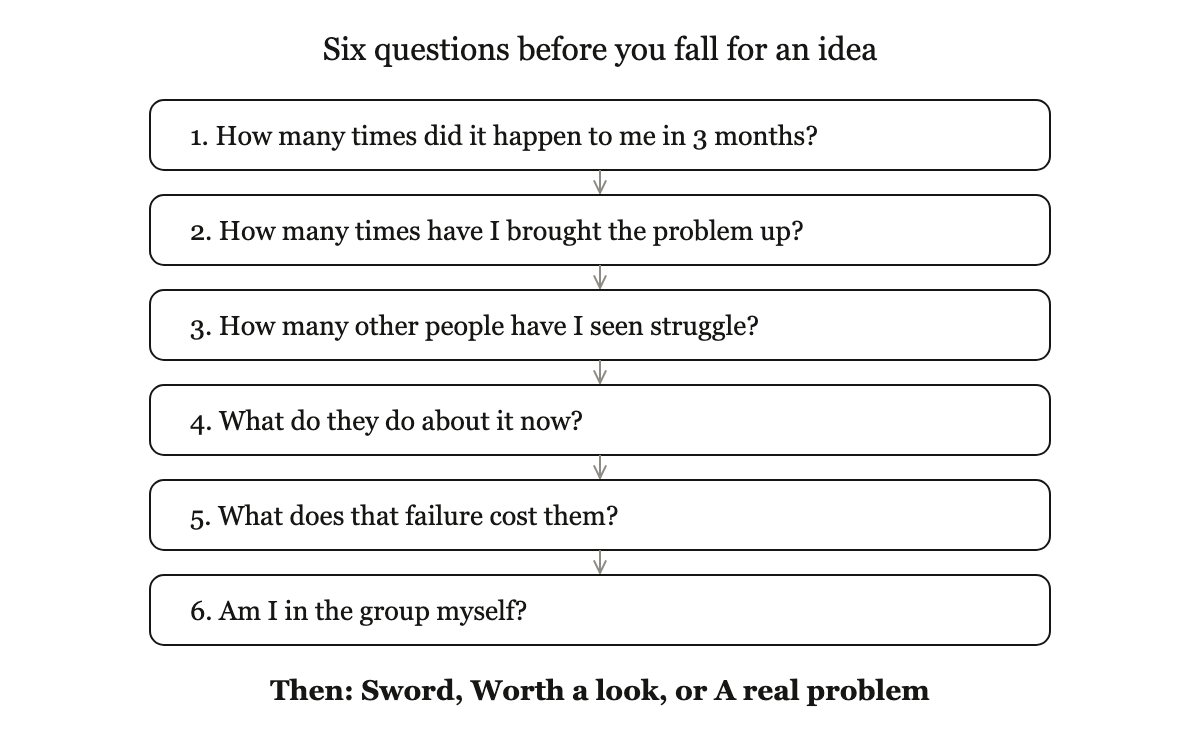
You come before them, and the past comes before the future.
To run it here, type your idea, then answer six questions: times it hit you in 3 months, times you raised it before, others you saw struggle, what they do now, what that costs, and whether you are in the group.
When unsure, round down.
A made-up example: an indie hacker wants to ship a tool "small accountants could use" by Sunday, scores zero, and asks two accountants about month end instead.
The clearest pass in my own work is the Earshot Teleprompter, an iPhone app that helps you write a script, read it while looking at the lens, and edits the take for you. It is mine, so weigh that. The pain came first: talking to the lens and cutting the take hurt every time I recorded. I met the enemy before the sword.
Love the problem. Keep the sword down until you have met it.
Read the full article on Medium
Sources
- Paul Graham, "How to Get Startup Ideas" (November 2012)
- Carmen Nobel, "Clay Christensen's Milkshake Marketing," Harvard Business School Working Knowledge (February 14, 2011)
- The Mom Test, official book site by Rob Fitzpatrick
- Rob Fitzpatrick quote on the three Mom Test rules, Goodreads
- CB Insights, "The top 9 reasons startups fail" (March 5, 2026)